Skip to content
Sri Lankan origin and process

Ceylon Cinnamon:
Origin, Production and Quality

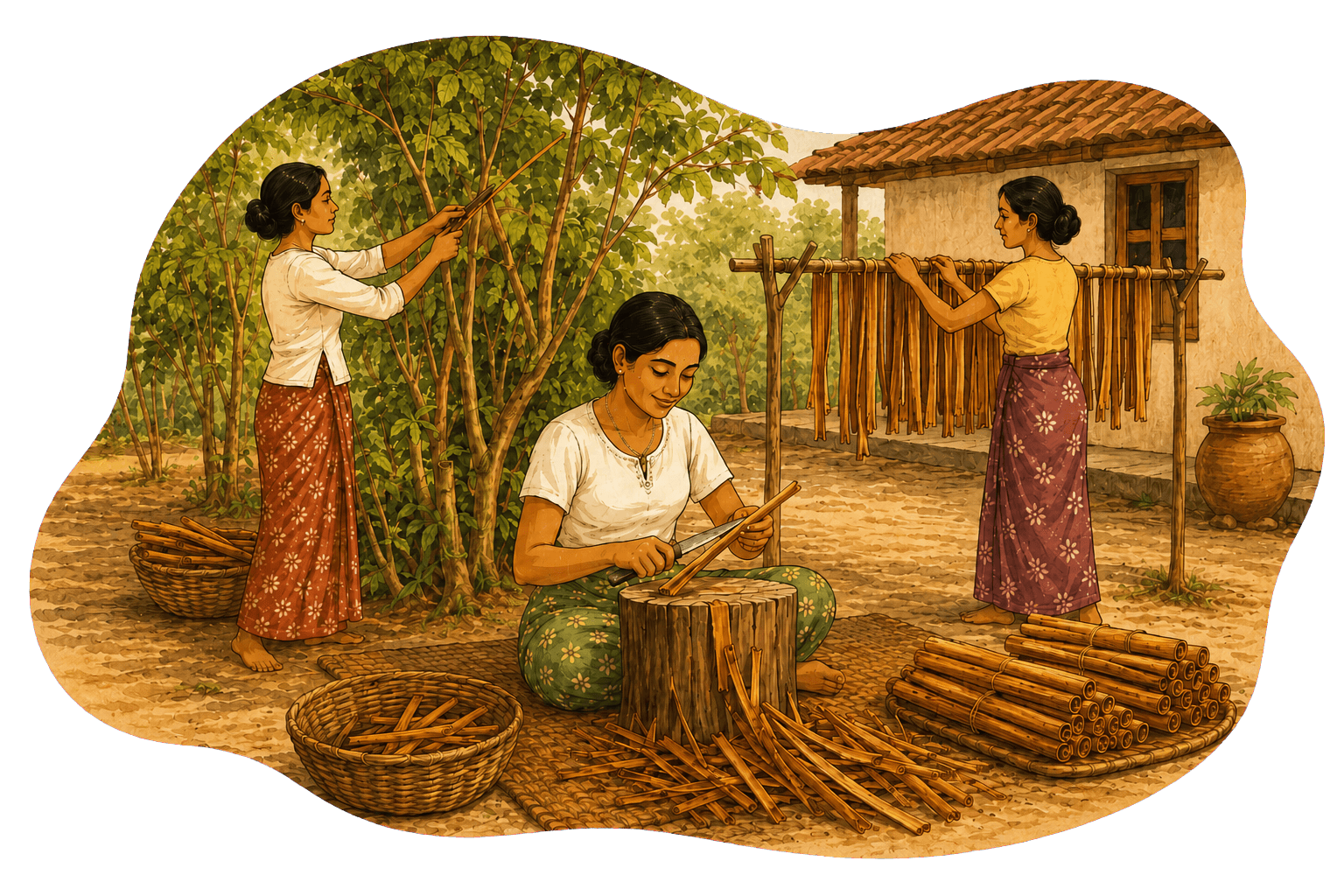
Ceylon cinnamon begins with cinnamon stems grown in Sri Lanka and is transformed through skilled scraping, peeling, rolling, filling, drying and grading.
Cinnamomum verumSri Lankan originTraditional quill process
Illustration of Sri Lankan women harvesting, peeling and drying Ceylon cinnamon
Origin

Where Ceylon cinnamon is grown

Ceylon cinnamon (Cinnamomum verum) is native to Sri Lanka. Commercial cultivation is established across several districts, with substantial production in the island's south and southwest.

An origin statement identifies where cinnamon was grown; it does not by itself confirm a particular farm, district, harvest period or lot. Those details should be stated only when records for the offered lot have been verified.

Six-stage process

From harvested stem to graded quill

Traditional quill production combines skilled handwork with measurable grading criteria.

Read the detailed Learn guide
0101

How stems are harvested

Suitable mature stems are cut cleanly, then immature sections, side branches and leaves are removed before the stems are taken to the peeling area.

0202

Scraping and peeling

The outer bark is scraped away. The prepared stem is rubbed to loosen the inner bark, which is lifted in sheets or peeled into narrower strips.

0303

Rolling and filling quills

Inner-bark sheets are overlapped and filled with smaller pieces of the same cinnamon bark to create the characteristic layered quill.

0404

Drying

The formed quills are shade-dried on clean strings, racks or nets. Drying allows the layered bark to curl and set into its finished form.

0505

Cutting and grading

Whole quills are prepared at approximately 42 inches (105 cm), then graded using maximum diameter, whole quills per kilogram and permitted surface foxing.

0606

Storage and packing

Dried cinnamon should be kept clean, dry and protected from moisture, contamination and physical damage. Final packing is agreed for the product, quantity, destination and shipping method.

Product forms

Whole quills, cut quills, quillings, featherings and chips

These product forms are not interchangeable. Quotations should name the required form and any limits that matter to the buyer.

Read the detailed Learn guide
01

Whole quills

Layered Ceylon cinnamon quills prepared at approximately 42 inches (105 cm) and classified under the applicable whole-quill grade.

02

Cut quills

Whole graded quills cut to an agreed shorter length while retaining their whole-stick form.

03

Quillings

Whole quills broken into pieces shorter than 200 mm. Buyer specifications should address permitted featherings, bark pieces and other extraneous material.

04

Featherings

Small pieces of inner bark that break away during quill preparation and handling.

05

Chips

Pieces of mature bark that cannot be peeled conventionally and are separated by scraping or beating.

Product assessment

Quality factors

Whole-quill grades use maximum diameter, the number of 42-inch quills required to make one kilogram, and the permitted percentage of surface foxing. Product form, cleanliness, moisture, packing and buyer-specific analytical requirements should also be agreed for the relevant shipment.

Lot-specific records

CeyQuills sourcing information

Source district, processing period, lot number, actual-lot images and available documents are provided only when verified for the product being quoted. No farm-level traceability or unrecorded supply-chain claim is implied by this page.

SLS 81:2021 reference

Understand the grade limits

Compare the official diameter, quill-count and foxing limits before requesting a current lot.

View all grades →
01

Maximum diameter

The permitted outer diameter of the quill.

02

Quills per kilogram

The minimum number of 42-inch quills required to make one kilogram.

03

Surface foxing

The maximum permitted percentage of visible surface foxing.