Key points
- There is no universal quantity that suits every quill or recipe.
- Bark thickness, size, age and personal preference affect flavour.
- Begin conservatively, taste during preparation and adjust.
- Remove or strain bark when it is no longer needed in the finished dish.
- Do not present cinnamon tea or recipes as medical treatment.
Tea and herbal infusions
- Use a short quill or broken pieces.
- Add to water and gently simmer or steep until the desired aroma develops.
- Longer contact generally produces a stronger infusion.
- Remove or strain the bark before serving.
- Do not present cinnamon tea as a treatment for any health condition.
Coffee and hot chocolate
- Add a short quill to the brewing vessel.
- Simmer or infuse it in milk, water or hot chocolate.
- A quill may also be used as an aromatic stirrer.
- Remove before serving when it would interfere with drinking or texture.
Rice, curries, stews and syrups
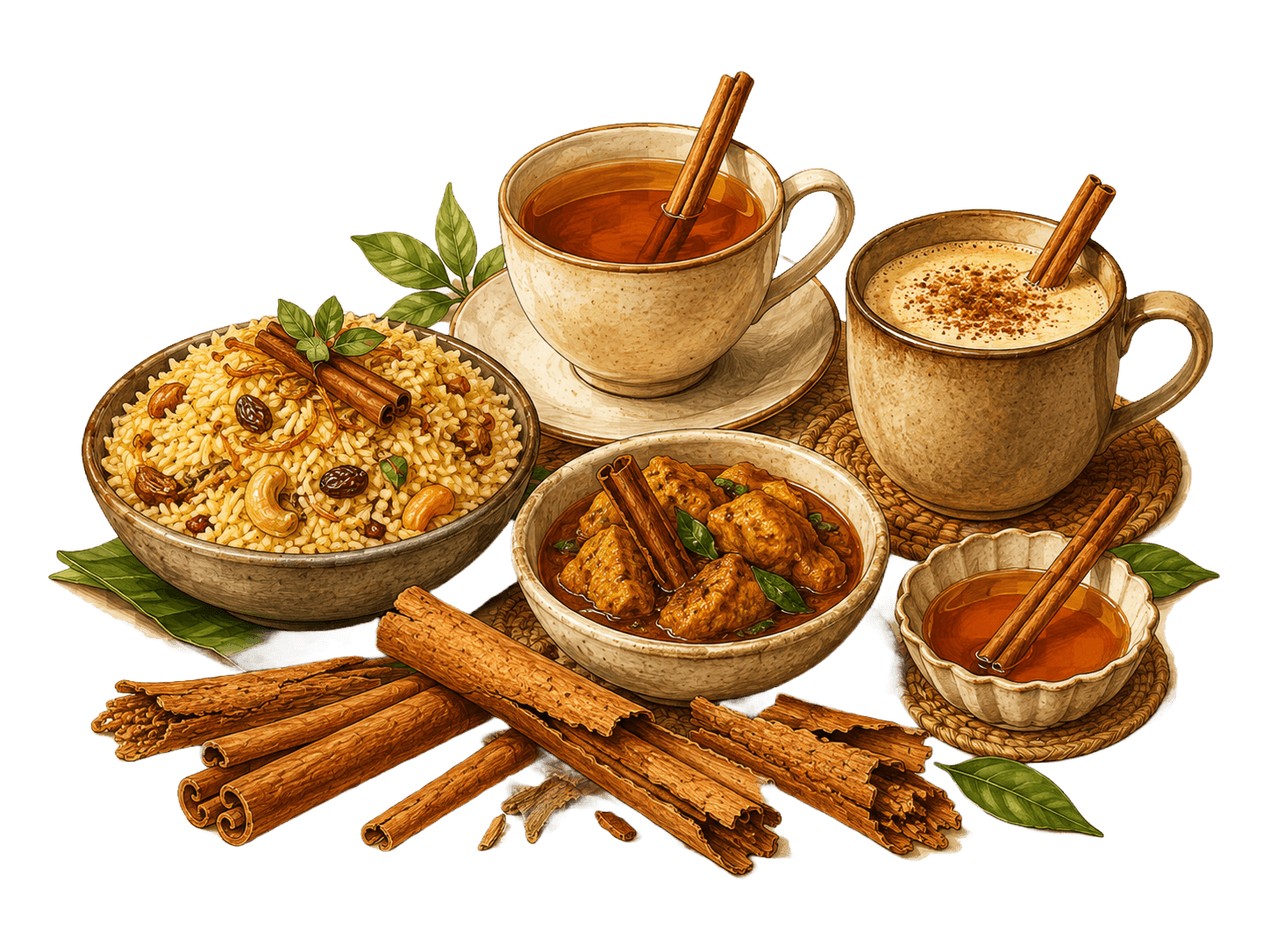
Whole quills work well in slow or wet preparations because the bark can infuse and then be removed. Add a small piece early, taste during cooking and remove when the flavour is sufficient.
For syrups, simmer gently and strain the liquid before cooling and bottling. Follow safe food-handling practices for any perishable preparation.
Desserts and baking
Quills can flavour custards, poaching liquid, milk, cream, fruit preparations and sauces. Ground cinnamon is usually more practical when the spice must remain evenly distributed in a dry batter or dough.
Can a cinnamon quill be reused?
A clean quill used briefly in hot water may give a second mild infusion, but flavour becomes weaker and reuse cannot be guaranteed. Do not advise long-term storage of a wet used quill.
- Do not reuse a quill that has remained at room temperature in milk or another perishable food.
- Do not reuse a quill that smells musty or unpleasant.
- Do not reuse a quill that shows mould or contamination.
- Do not reuse a quill that has remained damp during storage.
- For best quality, use a fresh piece when consistent flavour is important.
Common mistakes
- Using too much before tasting.
- Leaving a quill in a finished product indefinitely.
- Confusing quill decoration with an edible serving piece.
- Grinding more than can be used while aromatic.
- Storing cinnamon beside moisture, steam or strong odours.
- Making medical promises about a culinary recipe.
Simple preparation ideas
| Idea | How to use the quill |
|---|---|
| Simple cinnamon tea | Steep or gently simmer a small piece, then strain. |
| Cinnamon-infused coffee | Infuse in water, milk or the brewing vessel. |
| Cinnamon rice | Add a short piece during cooking and remove before serving. |
| Cinnamon syrup | Simmer in syrup and strain before storage. |
Sources and further reading
Related guides
How to Store Cinnamon
Protect whole quills and powder from moisture, heat, sunlight, contamination and aroma loss.
7 min read
The Four Main Commercial Types of Cinnamon
Compare Ceylon, Chinese cassia, Indonesian Korintje and Vietnamese Saigon cinnamon.
8 min read
Ceylon Cinnamon vs Cassia
Learn how bark structure, botanical species, flavour profile and the coumarin discussion differ between Ceylon cinnamon and common cassia varieties.
7 min read